US inflation jumps to highest level in almost two years

 Getty Images
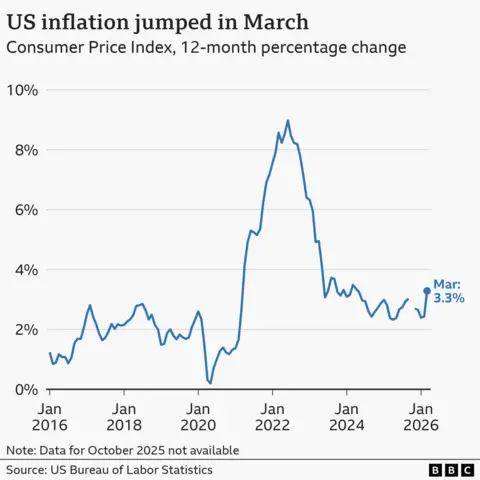
Inflation in the US accelerated last month to its highest rate in nearly two years, as surging oil prices triggered by the US-Israel war in Iran started to spill over into the wider economy.
Consumer prices climbed 3.3% over the 12 months to March, picking up from 2.4% in February, the Labor Department said.
The jump, which was expected, marked the biggest monthly change since 2022, when the world was dealing with an energy shock brought on by Russia’s invasion of Ukraine.
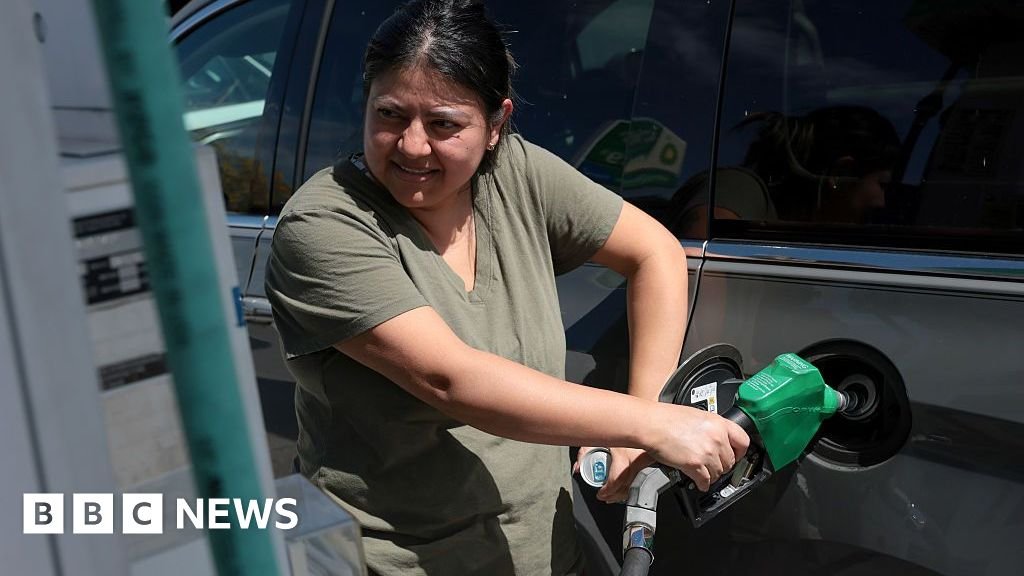
Last month's increase was driven by a surge in prices at the pump, as the war’s shutdown of the Strait of Hormuz sent oil prices soaring.
Gas prices rose 21.2% from February to March – the biggest monthly increase since the government started tracking the figures in 1967. Prices for fuel oil jumped more than 30% in the biggest surge since February 2000.
'Paying more'
The impact has been particularly visible in states such as California, where gas prices were already higher than the rest of the US.
On Thursday, the average cost of a gallon of gas in California was $5.93, compared to the nationwide average of $4.16, according to the American Automobile Association.
Annel Villegas, 23, said the cost was "terrible", using an expletive for emphasis.
"I drive a truck, so I fill it up every half tank, and now it's like, $70 (£52), $80," she said, adding that she had tried to limit her driving as much as possible due to the jump in gas prices.
Still, she said: "I have to do what I have to do to live …. I'm just dealing with whatever it brings to me – so, paying more."
The spike in gas prices accounted for nearly three quarters of the rise in inflation from February to March.
Prices for airline tickets and clothing also increased over the month, reflecting a mix of higher energy prices and the lingering impact of tariffs, as firms continue to pass those costs onto customers.
Food prices were unchanged from February to March, but analysts said those may rise in the months ahead, as the impact of higher transportation and fertiliser costs starts to be felt.
"For now, this looks like an energy-led re-acceleration with contained spillovers, rather than a fully entrenched second-round inflation dynamic," said Arielle Ingrassia, associate director at UK wealth manager Evelyn Partners.
"However, if energy prices remain elevated, the risk is that these effects broaden over time through costs, pricing and ultimately inflation expectations."
The Strait of Hormuz is a critical passage for commodities such as natural gas, fertiliser, aluminium and helium, as well as oil.
While talks between the US and Iran have raised hopes that the waterway could re-open to ship traffic, analysts have warned that it may take time for energy supplies to normalise. Oil prices have retreated from their recent highs, but remain significantly higher than before the conflict.

As campaigns for mid-term elections in November heat up, the situation has put Republicans on the defensive.
Rosa Cano, 37, estimated that the last time she filled up her Jeep, it cost her roughly $140, compared to the $80 she typically spent. She said she blamed the situation on the war.
"I'm wondering why we're in this war," said Cano, who drove over an hour in heavy traffic from the Inland Empire region into downtown Los Angeles to shop for her daughter's baptism. "It is unnecessary. As a country, we should make better decisions."
US President Donald Trump has maintained the jump in energy prices will be short-lived, dismissing concerns about risks to the wider economy.
In a statement on social media on Friday, White House spokesman Kush Desai spotlighted declines in prices for prescription drugs and staples such as eggs.
"The American economy remains on a solid trajectory thanks to the Administration's robust supply-side agenda of tax cuts, deregulation, and energy abundance," he wrote.
Some analysts said they took heart from the fact that so-called core inflation was slightly more muted than expected, rising 2.6%. Core inflation is considered a better measure of underlying trends because it does not include food and energy prices, which tend to fluctuate.
Categories that have seen prices fall over the past year include medicine and used cars and trucks.
"Headline inflation is being driven higher by a temporary energy shock, but underneath the surface, core inflation continues to move in the right direction," Adam Schickling, US economist at Vanguard, said.
Still, the situation has dashed the hopes of many on Wall Street that the US central bank might lower interest rates this year.
"Transitory is the hope, but Fed officials will think twice before telling the public they expect inflation to be transitory, after having misjudged post-pandemic inflation and mislabelled it as such," Atakan Bakiskan, US economist at Berenberg said.
Reporting contributing by Kayla Epstein