Stormzy's stab vest goes on display in landmark exhibition of black British music

 PA Media
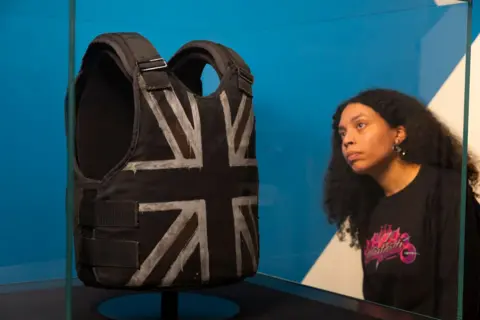
Stormzy's stab-proof vest, which he wore during his headline set at Glastonbury, is one of the centrepieces of a new exhibition highlighting 125 years of black British music.
The Music Is Black: A British Story is the very first installation at the brand new V&A East, which opens in London's Olympic Park this weekend.
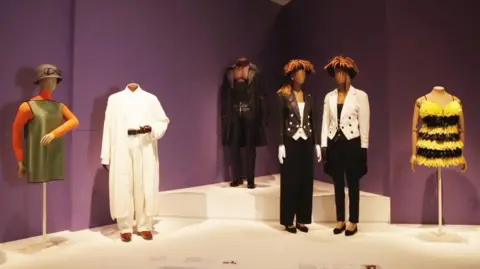
It also includes Joan Armatrading's childhood guitar, stage outfits from Seal and Poly Styrene, and the handwritten lyrics to Michael Jackson's Thriller.
The show traces how imported genres like jazz, reggae and the blues gave rise to the distinctly British sounds of Two Tone, Garage, Trip Hop and Grime.
Stormzy's vest, which was designed by Banksy and emblazoned with the Union Jack, is displayed near the end of the exhibition – illustrating how music can address issues of national identity, street crime, and prejudice.
"That's the beauty of street art, of graffiti, of rap music, is that it's making you think constantly about issues you don't really want to confront," says Jacqueline Springer, who curated the show for the V&A.
"This is about ambition pursued against legal restriction, against moral and against racial discrimination.
"What we're looking at here is the way that art always penetrates, always gets through."
 David Parry for the V&A
The exhibition frames Stormzy's statement – made as he became the first British rapper to headline Glastonbury – in a historical context of protest and rebellion.
Before we get to it, the gallery takes us on a cross-continental, decades-long journey, showing how music from Africa and the Caribbean was shaped by colonialism and religion, then transported to the UK, where it took on new life.
"Before rock and roll's rebellion, there was jazz," explains Springer. "Jazz's rebellion emerges from the blues, and the blues is a stripped down, less churchified, incarnation of gospel.
"And so you come to see that black music underpins popular music in America and Northwest Europe."
 Getty Images / David Parry for the V&A
One of the exhibition's most striking exhibits is Winifred Atwell's battle-scarred upright piano.
It was on this deliberately out-of-tune instrument, bought in a second-hand shop, that the Trinidad-born musician composed Let's Have Another Party – which became the UK's first number one single by a black artist in 1954.
The piano is pock marked with graffiti, etched into its body by fans – at Atwell's request – showing how she broke down racial barriers to become one of the UK's most prominent musicians, spending 117 weeks in the UK charts, and fronting her own shows on ITV and BBC television.
"What's key about Winifred is that her experience with prejudice, both racial and gendered, is that she factored it into her own activism," says Springer.
"When she was playing, she could look at all of these messages of adoration… [so] the entire instrument is this testimony to not only a particular musical genre, but also her relationship with her fans."
Other highlights Jerry Dammers' original sketches for the 2-Tone record label logo; the Nintendo console that grime star JME used to make his first tracks; and the dress Dame Shirley Bassey wore for an Oscars' tribute to James Bond.
"How do you get Dame Shirley to lend you her dress? You have charm, you have wit, and you also say to them, 'Please, please, can we do it?'" laughs Springer.
 Getty Images
Walking through the exhibition, specially-programmed headsets react to the environment – creating a personalised DJ Mix as the music evolves from juke joints and jazz clubs to reggae nights, carnival and pirate radio.
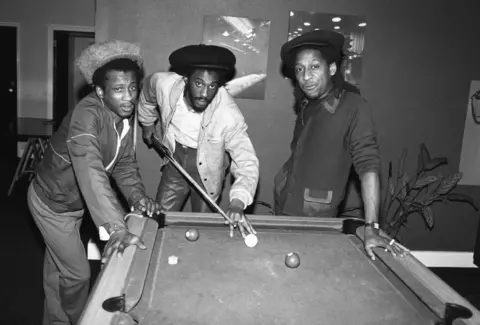
When we reach the 1970s, Britain begins to put its own spin on reggae with bands such as The Cimarons, UB40 and Aswad.
"There weren't really any British artists making reggae, so we had to set that path," reflects Aswad's Tony "Gad" Robinson.
As children of the Windrush generation, they didn't have "the sunshine, the palm trees, the mangoes and all those things" that inspired Jamaica's reagge and dub culture, he says.
"We went to British schools. It was cold. So all we could talk about was our experiences here. We didn't know it at the time, but that was our spearhead. That allowed people to connect with us, here in England."
 Getty Images
The exhibition illustrates how those early reggae bands were championed by venues like the Four Aces, which was founded by Newton Dunbar in East London.
Eventually, their success birthed British genres like Lover's Rock, Brit Funk, Drum and Bass and Garage.
In fact, of the eight British-born musical movements identified by the V&A, seven are direct descendants of reggae.
That reflects the findings of a recent report by UK Music, which stated that black music accounted for 80% of the UK music industry's £30bn revenue over the last three decades – thanks to its influence on everything from techno to pop.
"Black music has been big fixture in the UK," says neo-soul singer Omar, who's lent the V&A the bass guitar on which he wrote the 1990 hit There's Nothing Like This.
"We have a unique style. I like to call it 'Knees Up Mother Brown' meets 'Lively Up Yourself'.
"[It means] that sounds like grime, two-step and jungle could only come from the UK."
At the V&A, black music's cultural contribution becomes apparent, as you hear how 80s pop acts like Mel & Kim drew on the sounds of Chicago house; and Skunk Anansie's Skin put a punky British twist on hard rock.
For Robinson, the story being told at the museum is a powerful one.
"To have the exhibition means so much because it means it's been documented," he says.
"When we started back in 1976 there was nothing really here in England that we could look back on and say, 'Well, this is where we came from'.
"So when we talk Stormzy and jungle and sound systems, we can see how the kids have picked up what we did and taken it to another stage.
"It's definitely uplifting. And the greatest thing about it, is that it will carry on."
The Music Is Black: A British Story opens at the new V&A East Museum on Saturday, 18 April.
The BBC also has a season of programmes, mixtapes and educational resources to support the exhibition.