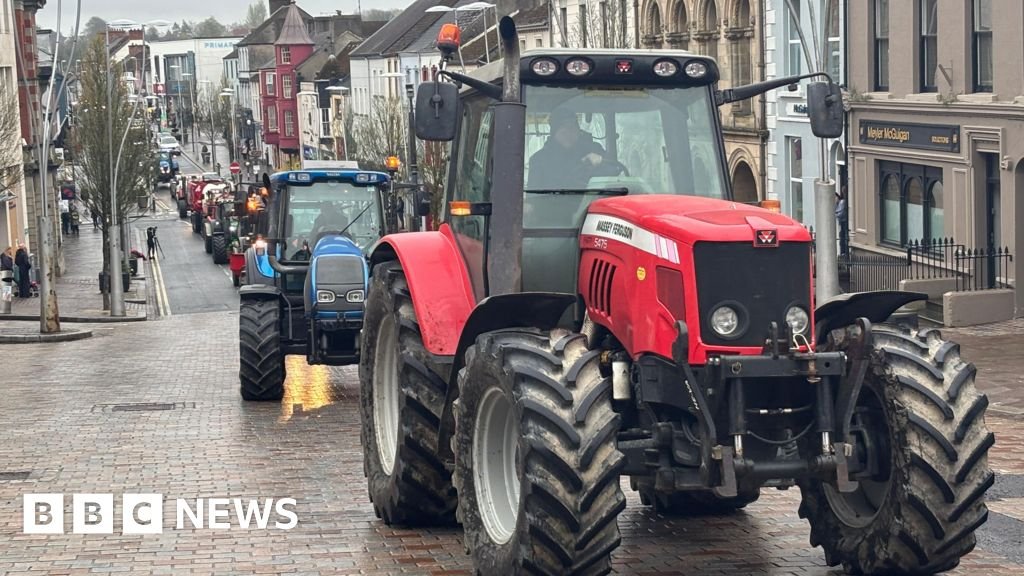
Fuel protests across NI as tractors and trucks disrupt traffic

 BBC
BBCSlow-moving vehicles have been causing disruption to traffic on a number of main roads in Northern Ireland as demonstrators object to rising energy bills.
Fuel costs have soared globally as a result of the US-Israel war with Iran.
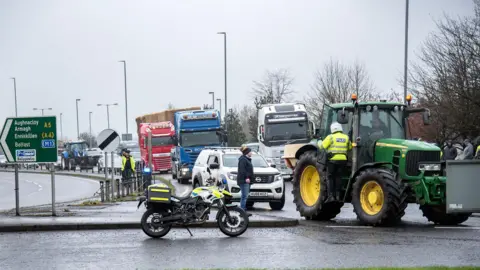
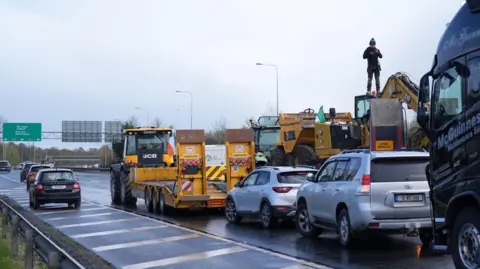
About 100 tractors and trucks are involved in a convoy between Ballygawley roundabout and the A4 Enniskillen roundabout.
Smaller protests also took place in other areas including Nutts Corner, Omagh, Toome Bridge and at the A1 approaching Hillsborough roundabout near Sprucefield, but traffic now appears to be returning to normal.
A video on social media appeared to show protesters at Toome Bridge being warned that they were causing an "unlawful obstruction" and they could be arrested if they did not move.
While at Ballygawley in County Tyrone police told protesters they would charge them with inconsiderate driving and they could be given three penalty points on their licenses if they do not leave.
Shortly after 14:00 BST, a number of slow-moving vehicles including tractors, lorries and pick-up trucks descended in the vicinity of the Ballygawley roundabout.
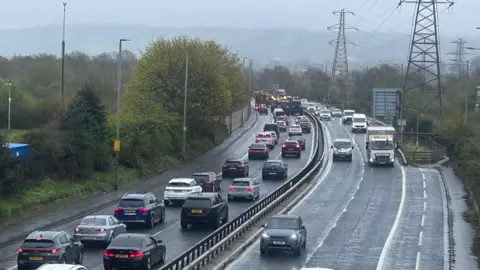
Less than a hour later, traffic had more or less come to a standstill.
'We are sick and tired of the cost of everything'
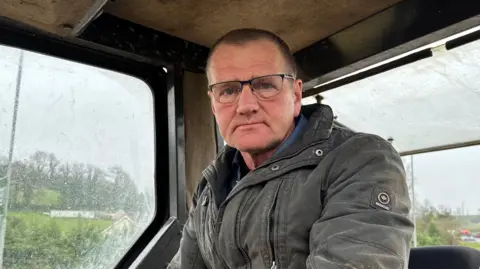
Farmers say they are being hit on several fronts, with the price of fuel and fertiliser all facing a hike.
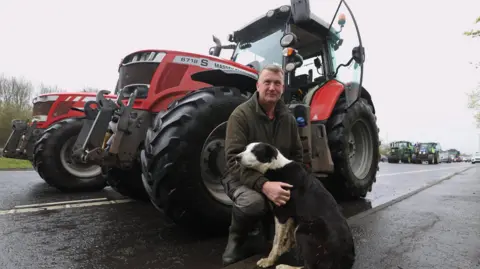
Farmer Stephen McKeown, who is taking part in the protest at Ballygawley, said he would rather be at home working but felt he had to take a stand.
"We are sick and tired of the cost of everything at the present time," he said.
"I don't mind paying tax but I really do detest when my money is being spent very foolishly."
He hoped Stormont would see how unhappy people were with spiralling costs, and "spend money more wisely".
 PA Media
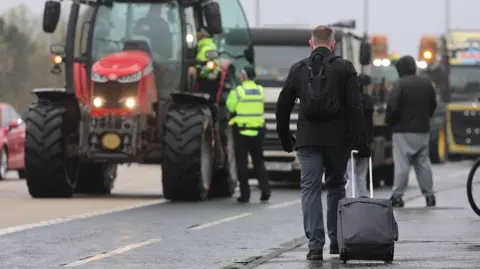
Earlier, there was a slow-moving convoy of tractors on the Sydenham bypass in both directions, but the road later cleared.
Some passengers who were heading to Belfast City Airport. could be seen pulling their luggage by the side of the road.
Belfast farmer Sam Hanna was among those taking part in the protest there.
 PA Media
He apologised for any disruption but said "we're doing it for them".
"It's not just for the farmer, it's for the ordinary housewife going in and getting her shopping, putting £20 or £40 or diesel or petrol into her car," he said.
"Fuel is not really that dear if you take the tax off it. We have money for everything else – we can spend overseas, we can help people coming to this country, we can't help our own people."
Meanwhile, Health Minister Mike Nesbitt has urged people not to block roads and to let healthcare workers reach their patients, adding that "disruption threatens life".
"Today as in every day there will be over 100,000 engagements between the health and social care service and the public, and thousands of them rely on the workforce getting from A to B in a timely manner", he said.
"My plea is let the health and social care system work as it is supposed to work".
 Pacemaker
Demonstrators in the Republic of Ireland had been blocking fuel depots and motorways for nearly a week.
Organisers in Northern Ireland say they are standing in solidarity with those across the border where hundreds of petrol stations are without fuel because of the protests.
Other developments:
- The ambulance service and fire service both appealed to the protesters to ensure access for emergency vehicles
- Belfast International Airport and Belfast City Airport advised passengers to give themselves "extra time" for their journey
- Police have prepared a response to minimise disruption and ensure public safety
- Department for Infrastructure advised people to allow extra time for their journeys
- Translink has advised people to check its website for updates on how their services are affected
- St Ciaran's College, in Ballygawley, County Tyrone, closed ahead of any potential disruption
 Michael Cooper
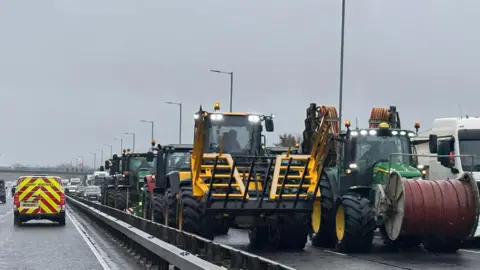
Dozens of vehicles took part in a slow-moving convoy in Strabane, County Tyrone, on Saturday.
Why are the protests taking place?
Some 20% of the world's oil trade, the raw ingredient for producing both petrol and diesel, has been halted by the closure of the Strait of Hormuz.
In Northern Ireland, petrol increased from 124.8p litre on 26 February to 153.1p litre on Thursday, while diesel prices have gone from 132.6p litre to 185.6p litre, according to the Consumer Council.
The conflict in the Middle East has seen household energy and food bills rise, with businesses also feeling the pinch.
The managing director of Lynas Foodservice in Coleraine, County Londonderry, told BBC Radio Foyle's North West Today programme his fuel bill has jumped by about £20,000 a week.
The first and deputy first minister have sent a joint letter to the prime minister calling for the government to intervene on rising costs.
On Monday, Michelle O'Neill said the executive was "carrying the can" for policy decisions made in London.
The first minister said: "The executive is in a really, really difficult financial position because of decisions that have been taken in London and we are trying to protect people from those decisions.
"People understand that the assembly has a limited number of fiscal powers, the levers that you reach for to help people actually sit in Westminster, whether that is cutting tax on fuel, then it has to be done at a Westminster level."
 PA Media
DUP leader Gavin Robinson said he did not want to see any disruption to emergency services or medical appointments as a result of fuel protests.
"We all know the pressures people are facing, we can see how much this crisis is hurting and we understand the need for a response," he said.
"In Dublin the protests were targeted at a government who have levers at their disposal.
"Whilst I understand and support people's right to protest, it is important to reflect at this stage that I don't think we would benefit from widespread disruption.
"I don't think anyone who is struggling with fuel costs would benefit from sitting in an idling queue with their engines turning over and their fuel being wasted."
Although blockades at fuel depots and Ireland's only oil refinery have been lifted, slow-moving convoys of large vehicles continued on motorways around Dublin on Monday morning.
On Sunday, the Irish government announced a €505m (£440m) package to support those most affected by rising fuel costs. It comes on top of measures worth €250m which were announced almost three weeks ago.